




 For most of the hearing aid industry's history, accessing a hearing aid meant accessing an audiologist first. An appointment. A hearing test. A fitting session. Follow-up visits. And a bill that, for most people without comprehensive insurance coverage, ran into the thousands of dollars before a single device was worn. For the millions of adults with mild-to-moderate hearing loss who needed help but couldn't navigate or afford this system, the result was simple: they went without.
In 2026, that system is no longer the only option. Non-prescription hearing aids — fully legal, genuinely capable, and available directly online without a clinical visit — have opened the hearing aid market to the people the prescription model consistently failed to reach. This guide covers everything you need to know: what OTC hearing aids are, who they're right for, how they compare to prescription devices, and which options lead the category.
Can You Buy Hearing Aids Without a Prescription in 2026?
Yes. Since the FDA's 2022 OTC ruling, adults with mild-to-moderate hearing loss can buy hearing aids without a prescription or audiologist visit. Non-prescription hearing aids are available directly online, require no clinical fitting, and start from $299. The ELEHEAR range leads this category with AI-powered VOCCLEAR® technology.
What the FDA's OTC Ruling Actually Changed — And Why It Matters
The FDA's October 2022 ruling establishing the over-the-counter hearing aid category was one of the most significant regulatory changes in the history of consumer hearing health. Understanding what it actually changed — and what it didn't — is the foundation for making an informed decision about non-prescription hearing aids in 2026.
What the Ruling Changed
Before the 2022 ruling, all hearing aids — regardless of the degree of hearing loss they were intended to address — required a prescription and professional fitting by a licensed audiologist or hearing instrument specialist. This requirement applied even for mild hearing loss cases that could be addressed effectively with standardized amplification and processing. The clinical requirement added cost — audiologist fees, fitting fees, follow-up visit fees — and created access barriers for people in areas with limited audiology services, people without flexible scheduling, and people without insurance coverage for hearing care.
The FDA's ruling created a new regulatory category: over-the-counter hearing aids for adults 18 and older with perceived mild-to-moderate hearing loss. Devices in this category can be sold directly to consumers — online, in retail stores, or through any direct-to-consumer channel — without a prescription, without a clinical fitting, and without any professional intermediary. The ruling applied to a specific and well-defined population — adults with self-perceived mild-to-moderate hearing loss — and did not extend the OTC category to severe or profound hearing loss, which continues to require professional audiological management.
What the Ruling Didn't Change
The OTC ruling did not change the clinical standard of care for severe or profound hearing loss. It did not eliminate the value of professional audiological services for complex cases. And it did not establish any minimum performance standard that distinguishes genuinely capable OTC hearing aids from basic sound amplifiers — which is why understanding what to look for in an OTC device matters as much as understanding that OTC devices are now legal.
Why It Matters in 2026
The practical impact of the 2022 ruling has become fully apparent by 2026. A new generation of direct-to-consumer hearing aid brands — built from scratch around the OTC model — has entered the market with devices that apply genuine AI processing, Bluetooth connectivity, and smartphone app control to the OTC category. The best over the counter hearing aids in 2026 are not compromised versions of prescription devices. They are purpose-built OTC products designed for direct-to-consumer delivery, priced to reflect the technology cost rather than the full clinical delivery infrastructure.
The result is a market where adults with mild-to-moderate hearing loss have real, high-quality options available without a prescription — and where the price difference between OTC and prescription hearing aids for this population is not justified by a proportional performance difference.
Who Are Non-Prescription Hearing Aids Right For?
OTC hearing aids are designed for a specific population — and understanding whether you fall within that population is the most important step in determining whether a non-prescription device is the right starting point.
Adults 18 and Older With Mild-to-Moderate Hearing Loss
The FDA's OTC category is specifically designed for adults 18 and older who have self-perceived mild-to-moderate hearing loss. Mild-to-moderate hearing loss is the most common degree of hearing loss among adults — it describes the experience of struggling to follow conversations in noisy environments, frequently asking people to repeat themselves, turning up the TV louder than others prefer, and missing high-frequency sounds like consonants in speech.
If these experiences describe your daily life, OTC hearing aids are likely appropriate for your hearing loss profile. If you're uncertain, ELEHEAR offers a free online hearing test at elehear.com that provides a baseline assessment in minutes — confirming OTC eligibility without an audiologist appointment.
First-Time Hearing Aid Seekers
For adults recognizing hearing difficulty for the first time, the OTC model provides a low-barrier entry point into hearing care. Rather than committing immediately to a multi-thousand-dollar prescription device and a clinical relationship, first-time buyers can access genuine AI hearing aid technology at OTC prices — experiencing the benefit of hearing support before deciding whether to pursue clinical care.
Budget-Conscious Buyers
The prescription hearing aid model prices quality devices out of reach for many adults — particularly seniors on fixed incomes, uninsured buyers, and adults without comprehensive hearing benefits. Best non prescription hearing aids 2026 deliver AI-powered performance at OTC prices that make meaningful hearing support financially accessible for the first time to the populations that have historically been most underserved by the prescription model.
Buyers Who Prefer Self-Managed Health Care
A growing proportion of adults — across all age groups — prefer to manage their health care independently through direct-to-consumer channels rather than through clinical intermediaries. For this population, the OTC model's combination of online purchase, app-guided self-fitting, and independent adjustment capability aligns with a broader preference for autonomous health management that the prescription model's clinic-dependent structure doesn't accommodate.
Who OTC Is NOT Right For
Adults with severe or profound hearing loss require the more powerful receivers and precise clinical fitting that prescription devices provide. Children under 18 are outside the OTC category entirely and require professional audiological management. And adults with sudden onset hearing loss, asymmetric hearing loss, or hearing loss accompanied by pain, dizziness, or discharge should seek medical evaluation before purchasing any hearing device — as these symptoms may indicate conditions requiring medical treatment rather than amplification.
OTC vs. Prescription Hearing Aids — What's the Real Difference in 2026?
The honest answer to this question has changed significantly since the OTC category was created. In 2022, the first wave of OTC devices were largely basic amplifiers that offered accessibility without meaningful performance. By 2026, the best OTC hearing aids have closed the performance gap to a point where it is no longer the defining factor in the comparison for mild-to-moderate hearing loss users.
Where OTC and Prescription Are Now Comparable
For mild-to-moderate hearing loss, the AI processing capability, Bluetooth connectivity, app control, water resistance, and rechargeability of the best 2026 OTC hearing aids match or approach prescription devices at comparable or higher price points. The ELEHEAR range — powered by VOCCLEAR® AI — delivers real-time speech-noise separation, adaptive environment management, self-fitting with personalized profiles, and full Bluetooth streaming at prices that start at $299. These are not compromised features — they are the complete modern hearing aid feature set delivered without prescription pricing.
Where Prescription Still Leads
Prescription hearing aids retain genuine advantages for specific user categories. Professional audiological fitting with sophisticated fitting software adds clinical value for complex, asymmetric, or severe hearing loss patterns. Proprietary accessory ecosystems — remote microphones, TV adapters, partner microphones — extend prescription devices into situations where OTC device microphones face physical limits. And ongoing audiologist-managed hearing care provides a clinical support relationship that OTC self-management doesn't replicate for users who want or need it.
The Price Reality
The most significant difference between OTC and prescription hearing aids in 2026 is price — and the gap is large enough to drive the decision for the majority of buyers with mild-to-moderate hearing loss. Prescription hearing aids typically cost $2,000 to $6,000 per pair through audiology clinics. The best OTC options — including the ELEHEAR range — deliver AI-powered performance from $299 to $599 per pair. For users in the mild-to-moderate range where OTC devices are designed to perform, this price difference is not offset by a proportional performance advantage on the prescription side.
The Best Non-Prescription Hearing Aids of 2026 — Compared
| Feature | ELEHEAR Beyond Pro | ELEHEAR Beyond | ELEHEAR Delight | Basic OTC Amplifier |
|---|---|---|---|---|
| AI Processing | Yes — VOCCLEAR® | Yes — VOCCLEAR® | Yes — VOCCLEAR® | No |
| Real-Time Noise Reduction | Yes | Yes | Yes | No |
| Bluetooth Streaming | Yes | Yes | Yes | Rarely |
| App Control | Yes | Yes | Yes | No |
| Self-Fitting | Yes | Yes | Yes | No |
| Rechargeable | Yes | Yes | Yes | Varies |
| IP Rating | IP68 | IP68 | IP68 | IPX2–IPX4 |
| Form Factor | BTE — Premium | BTE — Standard | ITC — Earbud Style | Earbud or BTE |
| Prescription Required | No | No | No | No |
| HSA/FSA Eligible | Yes | Yes | Yes | No |
| Price | $599/pair | $399/pair | $299 | $30–$150 |
The table reveals the structural reality of the 2026 non-prescription hearing aid market. Basic OTC amplifiers and the ELEHEAR range are both available without a prescription — but they occupy entirely different functional categories. Basic amplifiers offer OTC accessibility without AI processing, without app control, without meaningful water resistance, and without Bluetooth. The ELEHEAR range delivers the complete modern hearing aid feature set — AI processing, Bluetooth, app control, self-fitting, IP68 protection — at OTC prices across three form factor options. For buyers who want hearing aids without audiologist visit that actually perform in real-world conditions, the ELEHEAR range is the clear choice.
ELEHEAR — The Best OTC Hearing Aid Range to Buy Online in 2026
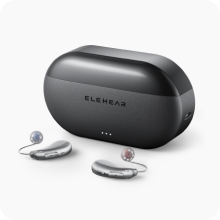
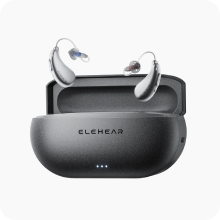
The ELEHEAR range is built around a single core technology — VOCCLEAR® AI — deployed across three distinct form factors and price points that cover the full range of OTC buyer needs. All three models are available directly at elehear.com without a prescription, are HSA and FSA eligible, and include access to ELEHEAR's free online hearing test for eligibility confirmation before purchase.
ELEHEAR Beyond Pro — The Premium OTC Option at $599 Per Pair
The best OTC hearing aids 2026 in the ELEHEAR range, the Beyond Pro brings the most advanced implementation of VOCCLEAR® AI processing available in the non-prescription market. For buyers who want maximum AI performance — in demanding acoustic environments, complex listening situations, or simply as a preference for the highest available technology — the Beyond Pro delivers it at $599 per pair.
At this price, the Beyond Pro costs approximately 85% to 90% less than prescription hearing aids with comparable AI processing capability. For mild-to-moderate hearing loss users who don't require the clinical fitting and ecosystem accessories of premium prescription brands, the Beyond Pro offers the most compelling value proposition in the premium OTC segment.
Key specifications: Advanced VOCCLEAR® AI processing, premium BTE form factor, Bluetooth connectivity, app control, self-fitting, IP68 water resistance, HSA/FSA eligible, no prescription required, $599 per pair.
ELEHEAR Beyond — The Best Value OTC Option at $399 Per Pair
The affordable hearing aids benchmark in the ELEHEAR range, the Beyond brings VOCCLEAR® AI processing to the most accessible full-featured price point in the range. At $399 per pair, the Beyond delivers genuine AI noise reduction, Bluetooth streaming, app control, self-fitting, and IP68 water resistance in a standard BTE form factor — making it the right choice for first-time OTC buyers and budget-conscious buyers who want real AI performance without the Beyond Pro investment.
The Beyond is the entry point into the ELEHEAR AI hearing aid experience — and as an entry point, it is significantly more capable than anything the basic OTC amplifier market offers at any price. For buyers who can only justify one ELEHEAR purchase, the Beyond delivers the complete VOCCLEAR® AI package at the most accessible price the range offers in a full-featured device.
Key specifications: VOCCLEAR® AI processing, standard BTE form factor, Bluetooth connectivity, app control, self-fitting, IP68 water resistance, HSA/FSA eligible, no prescription required, $399 per pair.
ELEHEAR Delight — The Discreet OTC Option at $299
For buyers who want VOCCLEAR® AI in the most discreet available OTC form factor — and at the most accessible price in the ELEHEAR range — the ELEHEAR Delight delivers at $299. As an ITC hearing aid, the Delight sits entirely inside the ear canal with no behind-the-ear component, reading as a modern consumer earbud from the outside and drawing no attention in any social, professional, or active context.
The Delight combines the full VOCCLEAR® AI processing capability with an ergonomic ear-wing stabilization system for secure active wear and IP68 water resistance — making it the most versatile option in the range for buyers whose lifestyle includes physical activity alongside the social and professional environments where hearing aids matter most.
At $299, the ELEHEAR Delight is the most affordable genuine AI ITC hearing aid available in the non-prescription market in 2026 — and for buyers whose primary concern is discretion alongside performance, it is the strongest value in the entire OTC category.
Key specifications: VOCCLEAR® AI processing, ITC earbud-style form factor, ear-wing stabilization, IP68 water resistance, Bluetooth connectivity, app control, self-fitting, HSA/FSA eligible, no prescription required, $299.
How to Buy ELEHEAR Hearing Aids Online
Purchasing ELEHEAR hearing aids without a prescription is straightforward. Visit elehear.com, take the free online hearing test to confirm OTC eligibility and identify the right model for your hearing profile, select the device that matches your form factor preference and budget, and complete the purchase directly — with HSA or FSA payment accepted. The device arrives ready for self-fitting through the companion app, with no audiologist appointment required at any stage of the process.
For buyers who want to buy hearing aids online without navigating the prescription system, ELEHEAR's direct purchase model is the complete non-prescription experience — from eligibility confirmation through self-fitting to ongoing independent adjustment — managed entirely without clinical intermediaries.
Shop ELEHEAR Non-Prescription Hearing Aids — From $299, No Rx Required
Frequently Asked Questions
Can you buy hearing aids without a prescription in 2026?
Yes. The FDA's 2022 OTC ruling established a non-prescription hearing aid category for adults 18 and older with mild-to-moderate hearing loss. OTC hearing aids — including the full ELEHEAR range — are available directly online without a prescription or audiologist visit, starting from $299.
What is the difference between OTC and prescription hearing aids in 2026?
OTC hearing aids are available without a prescription for mild-to-moderate hearing loss and are priced to reflect technology costs without clinical delivery markup — from $299 to $599 per pair for AI-powered devices. Prescription hearing aids require audiologist fitting and typically cost $2,000 to $6,000 per pair, with genuine clinical advantages for severe hearing loss, complex audiological needs, and proprietary accessory ecosystems. For mild-to-moderate hearing loss, the performance gap between the best OTC and prescription devices has narrowed significantly by 2026.
Are non-prescription hearing aids as good as prescription ones?
For mild-to-moderate hearing loss, the best non-prescription hearing aids in 2026 — particularly those powered by genuine AI processing like ELEHEAR's VOCCLEAR® technology — deliver speech clarity and noise reduction comparable to prescription devices at a fraction of the cost. For severe or profound hearing loss, professional fitting and more powerful prescription receivers remain the clinically appropriate choice.
How do I know if I need a prescription hearing aid or an OTC one?
The determining factor is the degree of your hearing loss. Mild-to-moderate hearing loss — the experience of struggling in noise, asking for repetition, or turning up the TV — is the OTC-appropriate range. ELEHEAR's free online hearing test at elehear.com provides a baseline assessment in minutes that helps confirm OTC eligibility. If your results indicate severe or profound loss, a professional audiological evaluation is the appropriate next step.
Are non-prescription hearing aids covered by HSA or FSA?
Yes. ELEHEAR hearing aids — including the Beyond Pro, Beyond, and Delight — are HSA and FSA eligible. Purchasing with pre-tax health spending funds reduces the effective out-of-pocket cost significantly, making non-prescription AI hearing aids even more accessible for buyers with health spending account balances.


