


Should You Get a Hearing Aid for Mild Hearing Loss?
Yes — treating mild hearing loss early with a hearing aid is one of the most effective preventive health decisions an adult can make. Research from Johns Hopkins found that even mild hearing loss (25 dB) doubles dementia risk. The 2023 ACHIEVE study showed hearing aid use reduced cognitive decline by 48% in high-risk older adults. Beyond cognitive health, mild hearing loss causes measurable listening fatigue, social withdrawal, and communication strain years before it is perceived as "serious enough" to treat.
[toc]
There is a common and understandable logic that keeps millions of adults from treating mild hearing loss: if you can still follow most conversations, if quiet settings feel manageable, if you are getting by — why spend money on a hearing aid?
The answer lies in what "getting by" actually costs. Not financially, but neurologically, socially, and cognitively. Mild hearing loss is not a stable, benign condition that stays mild indefinitely. It is the beginning of a process that, left unaddressed, quietly depletes cognitive reserve, strains relationships, narrows social engagement, and progresses — often for years before the person experiencing it recognizes how much has changed.
The best AI OTC hearing aids available in 2026 are specifically designed for early-stage hearing loss — discreet, capable, and priced to make early treatment a realistic choice rather than a deferred one.
What "Mild" Hearing Loss Actually Means
Mild hearing loss is clinically defined as a hearing threshold between 26 and 40 decibels — meaning you cannot comfortably hear sounds softer than 26 to 40 dB without amplification. In practical terms:
- Whispered conversations are difficult or impossible to follow
- Soft speech in a quiet room may be unclear
- Group conversations, restaurants, and meetings are noticeably harder than one-on-one settings
- Women's and children's voices, which occupy higher frequencies, may sound less distinct
- You frequently ask people to repeat themselves, particularly when not facing them directly
Because one-on-one conversations in quiet settings remain manageable, mild hearing loss is easy to rationalize as a situational inconvenience rather than a health condition. But the brain and body are already responding to the deficit — whether or not the person experiencing it recognizes the impact.
What Happens in the Brain During Mild Hearing Loss
The auditory cortex does not receive sound passively — it works. When hearing loss degrades the quality of incoming sound, the brain compensates by recruiting additional cognitive resources: attention, memory, context, and visual processing all contribute to filling the gaps that degraded auditory input leaves.
This compensatory effort is what researchers call cognitive load, and it is measurable and costly. Every conversation in a challenging environment, every strained phone call, every family gathering spent concentrating intensely to follow the room — each draws from the same cognitive reservoir that also supports memory, executive function, and processing speed.
Over months and years, this chronic diversion of cognitive resources accelerates what research calls cognitive reserve depletion — the process underlying the connection between untreated hearing loss and dementia.
The Johns Hopkins research that found mild hearing loss doubles dementia risk was not measuring severe or obvious disability. It was measuring a 25 dB threshold — exactly the level many adults dismiss as not worth treating.
The Hidden Daily Cost of Untreated Mild Hearing Loss
Listening Fatigue
One of the most consistently reported and least discussed consequences of mild hearing loss is the distinctive mental exhaustion that follows communication-intensive activities. Social events, work meetings, family gatherings — situations that others find stimulating or neutral — leave people with mild untreated hearing loss noticeably more drained.
This fatigue is not imaginary and it is not a personality trait. It is the direct physiological consequence of sustained cognitive effort to hear — and it reduces the energy and motivation available for everything else in the day. Many adults who begin wearing hearing aids report, with surprise, how much mental energy returns when they no longer have to strain to hear.
Social Withdrawal
The effort required to follow group conversations leads gradually and often imperceptibly to reduced social engagement. Fewer restaurant invitations accepted. Less participation in meetings. A growing preference for settings where hearing is easier — quiet, one-on-one, controllable.
This withdrawal is rational from a short-term effort management perspective and damaging from a long-term health perspective. Social engagement is one of the strongest known protective factors against cognitive decline and depression in aging adults. Mild hearing loss quietly erodes this protection years before the hearing loss itself is recognized as significant.
Relationship Strain
The people closest to someone with untreated mild hearing loss often notice it before they do. The repeated requests to repeat things. The responses that miss the point of what was said. The television volume that everyone else finds too loud. The withdrawal from group activities that used to be shared.
From the perspective of partners and family members, these patterns produce frustration, then worry, then — when communication fails to improve — a gradual reduction in the quality of shared connection. The person with hearing loss often interprets this distance as the other person's problem, unaware that their hearing is the common variable.
Accelerating the Loss Itself
Auditory deprivation — the state in which the brain's hearing centers receive consistently degraded input — has consequences beyond cognitive load. Research indicates that the auditory cortex reorganizes in response to chronic under-stimulation, with brain regions that normally process sound being recruited for other functions. This reorganization makes later adaptation to hearing aids more difficult and the outcomes less complete.
Early treatment with hearing aids maintains the auditory pathways in active use, preserving the brain's capacity to process sound clearly and making the transition to amplification — when inevitably needed — far smoother.
Why "Waiting Until It Gets Worse" Is Counterproductive
The most common rationale for delaying treatment — "I will address it when it becomes a real problem" — rests on an assumption that mild hearing loss and significant hearing loss are the same condition at different intensities, separated by a threshold of severity.
They are not. They are the same progressive process at different stages. And the earlier the intervention, the greater the benefit — for four compounding reasons:
Cognitive protection is greatest early. The ACHIEVE study's 48% reduction in cognitive decline applied to adults who began treatment before significant decline had already occurred. The protective effect of hearing aids is not equivalent at all stages — it is largest when the cognitive reserve it protects is still intact.
Auditory pathways are easier to maintain than to restore. Keeping the auditory cortex actively processing clear sound prevents the reorganization that makes later adaptation harder. Restoration of function after years of deprivation is more difficult and less complete than preservation of function from the start.
Social habits are easier to maintain than to rebuild. The social withdrawal that develops around untreated hearing loss becomes habitual. Reversing years of reduced engagement requires more than improved hearing — it requires rebuilding the social patterns and confidence that atrophied in the meantime.
The hearing loss itself will likely progress. Mild hearing loss does not stay mild indefinitely for most adults. Age-related progression continues, and treating loss while it is mild means starting from a better baseline as it changes.
What Modern Hearing Aids for Mild Hearing Loss Look Like
The practical barriers that historically kept people from treating mild hearing loss — cost, stigma, bulk, and inconvenience — have been substantially reduced by the current generation of OTC devices.
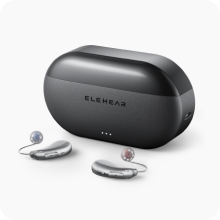
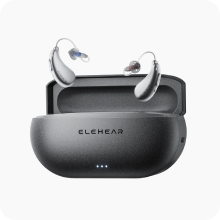
ELEHEAR Beyond — Starting at $399 per pair, FDA-cleared for mild to moderate hearing loss, available without prescription. The receiver-in-canal design sits discreetly behind the ear with a near-invisible wire to a small dome in the canal. At conversational distance, the devices are not noticeable to others.
ELEHEAR Delight — An ITC earbud-style design that sits inside the ear canal. For users who prioritize maximum discretion or who find the behind-the-ear format uncomfortable, the Delight offers AI-powered performance in a form factor that is routinely mistaken for consumer earbuds.
Both devices include VOCCLEAR® AI noise reduction — which directly addresses the speech-in-noise difficulty that is the primary complaint of mild hearing loss — Bluetooth audio streaming, rechargeable batteries, and app-based customization through the ELEHEAR app.
The best OTC hearing aids 2026 for users at the upper end of the mild range approaching moderate loss is ELEHEAR Beyond Pro, which offers enhanced AI processing for more demanding listening environments.
Starting the Process
ELEHEAR offers a free online hearing test at elehear.com — a ten-minute assessment that produces a hearing profile identifying which frequencies are affected and at what threshold. This provides the objective data to confirm whether your hearing falls in the mild loss range and to configure hearing aids appropriately.
The affordable hearing aids from ELEHEAR include a 45-day risk-free trial. The standard objection to treating mild hearing loss — "what if it is not worth it?" — is directly answered by the trial: wear the devices for six weeks in your actual daily life and evaluate the difference directly.
HSA and FSA payments are accepted, making it possible to purchase with pre-tax dollars.


