
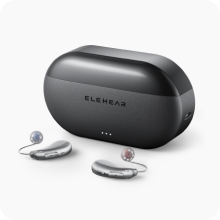
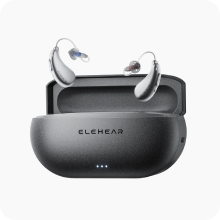


If you've been researching hearing aids and arrived at one firm conclusion — that you will not wear something hooked over your ear — you're not alone. The behind-the-ear component of traditional hearing aids is the single most common reason people who need hearing support continue to go without it. In 2026, that reason no longer holds. A new generation of hearing aids without a behind-the-ear part delivers genuine AI-powered hearing support in a form factor that sits entirely inside the ear canal — invisible, secure, and indistinguishable from a modern earbud.
This guide covers everything you need to know about ITC hearing aids in 2026: how they work, how they compare, and which option leads the category.
[toc]
What Is a Hearing Aid Without a Behind-the-Ear Part?
A hearing aid without a behind-the-ear part is an ITC — In-The-Canal — device that places the entire unit inside the ear canal with no external hardware. In 2026, the best OTC ITC option is the ELEHEAR Delight — discreet, Bluetooth-enabled, and powered by VOCCLEAR® AI at $299.
Why So Many People Are Choosing ITC Over BTE in 2026
The behind-the-ear hearing aid dominated the category for decades for straightforward engineering reasons: housing larger components behind the ear made it easier to fit bigger batteries, stronger processors, and more powerful receivers into a single device. For users with severe or profound hearing loss, that trade-off was unavoidable. For the millions of adults with mild-to-moderate hearing loss, it never needed to be.
What has changed in 2026 is that the engineering constraints that made BTE the default have largely been resolved. AI chip miniaturization has made it possible to run sophisticated real-time sound processing in a unit small enough to sit entirely inside the ear canal. Rechargeable battery technology has advanced to the point where rechargeable in ear hearing aids can sustain a full day of use without the bulk that BTE devices historically needed to achieve comparable battery life. Bluetooth radios have become compact enough to fit inside an ITC form factor without compromise.
At the same time, the FDA's 2022 OTC hearing aid ruling opened the market to direct-to-consumer brands that weren't constrained by legacy product architectures. These brands could build ITC devices from scratch — optimized for the form factor rather than adapted from existing BTE platforms. The result is a category of ITC hearing aids 2026 that offers genuine performance parity with BTE devices for mild-to-moderate hearing loss, at OTC prices, with no prescription required.
For users who have been waiting for a hearing aid that doesn't look like one, 2026 is the year the wait is over.
ITC vs. BTE vs. CIC — Understanding Your Options
Before choosing a hearing aid without a behind-the-ear part, it's worth understanding the full landscape of in-ear options and what distinguishes each:
BTE — Behind-The-Ear
The dominant traditional form factor. The main electronics unit sits in a casing that hooks over the outer ear, connected to an ear tip inside the canal via a tube or receiver wire. BTE devices are visible from conversational distance and immediately recognizable as hearing aids. They accommodate larger batteries and stronger receivers, making them appropriate for severe to profound hearing loss. For mild-to-moderate hearing loss, the visibility trade-off is unnecessary.
ITC — In-The-Canal
ITC hearing aids place the entire device inside the ear canal, sitting at the canal entrance or just inside it. There is no external casing, no hook, no tube, and no behind-the-ear component of any kind. From the outside, an ITC device is either not visible at all or reads as a small earbud. Modern in the canal hearing aids 2026 include Bluetooth connectivity, AI processing, app control, and rechargeable batteries — everything a BTE device offers, minus the external hardware. The ELEHEAR Delight is the leading OTC ITC option.
CIC — Completely-In-Canal
CIC devices go slightly deeper into the ear canal than ITC devices, achieving marginally greater concealment. The trade-off is that CIC devices are typically smaller in battery capacity, less likely to include Bluetooth or app connectivity, and harder to handle for users with dexterity limitations. In most real-world settings, the concealment difference between ITC and CIC is negligible — both are effectively invisible at conversational distance. The ELEHEAR Delight's ITC form factor achieves CIC-level discretion while retaining full modern connectivity.
RITE — Receiver-In-The-Ear
RITE devices are a hybrid: the main electronics sit behind the ear in a small casing, but the receiver is placed inside the ear canal. This reduces the size of the behind-ear component compared to standard BTE but does not eliminate it. RITE devices are not hearing aids like earbuds — they still have a visible behind-ear element and are still recognizable as hearing aids from a distance.
The Best ITC Hearing Aids of 2026 — Compared
| Feature | ELEHEAR Delight | CIC Prescription Device | Basic OTC ITC Amplifier |
|---|---|---|---|
| Form Factor | ITC — In-The-Canal | CIC — Completely-In-Canal | ITC or earbud |
| Behind-Ear Component | No | No | No |
| AI Noise Reduction | Yes — VOCCLEAR® | Varies | No |
| Bluetooth Streaming | Yes | Rarely | Rarely |
| App Control | Yes | Rarely | No |
| Rechargeable | Yes | Varies | Varies |
| Secure Active Fit | Yes — Ear-Wings | No | No |
| OTC Available | Yes | No — Rx required | Yes |
| HSA/FSA Eligible | Yes | Yes | No |
| Price | $299 | $2,000–$5,000+ | $30–$150 |
The comparison exposes a gap that has defined the ITC category until recently. Prescription CIC devices achieved genuine discretion but at extreme cost and without modern connectivity. Basic OTC ITC amplifiers offered accessibility without meaningful performance. The ELEHEAR Delight closes both gaps simultaneously — genuine ITC placement, genuine AI performance, full Bluetooth connectivity, and a price point that makes it accessible without compromise.
ELEHEAR Delight — The Best OTC ITC Hearing Aid of 2026
The ELEHEAR Delight is the answer to a question the hearing aid industry has been slow to address: what does a genuinely modern in ear hearing aid look like when it's designed for how people actually live in 2026?
The answer, in the case of the Delight, is an ITC device that places the entire unit inside the ear canal with no external components of any kind. No casing behind the ear. No tube running to the canal. No hook over the outer ear. From a normal conversational distance, the Delight is not visible. Up close, it reads as a modern earbud — the kind of thing that draws no attention whatsoever in any context where wireless earbuds have become part of everyday life, which in 2026 is essentially everywhere.
The ear-wing stabilization system keeps the device locked securely in place throughout a full day of activity — including exercise, commuting, and extended work sessions — without adding any visible external hardware. The companion smartphone app handles all sound adjustments, meaning there is no physical interaction with the device that a bystander would notice. The matte finish and compact silhouette complete a form factor that disappears completely into daily life.
What the ELEHEAR Delight delivers beneath that form factor:
- VOCCLEAR® AI Processing — ELEHEAR's proprietary speech clarity engine runs continuous real-time analysis of the acoustic environment, filtering background noise and enhancing speech automatically without any manual adjustment required
- ITC Form Factor — Entire device inside the ear canal; no behind-the-ear component, no external hardware, effectively invisible in everyday settings
- Ergonomic Ear-Wings — Secure mechanical stabilization for active wear; the device stays in place during running, gym sessions, and movement-heavy days without any visible external support
- Bluetooth Connectivity — Direct streaming from smartphone or any paired device for calls, music, podcasts, and all media
- App-Controlled Sound Profiles — Full sound customization managed from a companion smartphone app; volume, listening modes, and environment settings adjusted invisibly from your phone
- Rechargeable Battery — Full-day battery life with a compact charging case that fits in any pocket or bag
- OTC Accessible — No prescription required, no audiologist visit, available directly at elehear.com for adults with mild-to-moderate hearing loss
- HSA/FSA Eligible — Purchasable with pre-tax health spending funds, reducing the effective out-of-pocket cost
- Priced at $299 — The most capable OTC ITC hearing aid on the market at the most accessible price point
For anyone who has made the decision that a BTE hearing aid is not an option — for appearance reasons, comfort reasons, or lifestyle reasons — the ELEHEAR Delight is the device that resolves every remaining concern.
Shop the ELEHEAR Delight — The ITC Hearing Aid Built for Real Life
Who Is an ITC Hearing Aid Right For?
ITC hearing aids are not the right choice for every user. Understanding who benefits most from the form factor helps ensure you're making the right decision:
ITC Is the Right Choice If You Have Mild-to-Moderate Hearing Loss
OTC ITC hearing aids are designed and FDA-cleared for adults with mild-to-moderate hearing loss. If you're unsure where your hearing falls on the spectrum, ELEHEAR offers a free online hearing test at elehear.com that provides a clear baseline in minutes. The majority of adults who first notice hearing difficulty — struggling in noisy environments, asking people to repeat themselves, turning up the TV — fall within the mild-to-moderate range where ITC devices perform most effectively.
ITC Is the Right Choice If Appearance Matters to You
If the reason you haven't sought hearing support is how hearing aids look, ITC is the only form factor that fully addresses that concern. Earbud hearing aids in an ITC form factor eliminate the visual element that makes traditional hearing aids recognizable — and the ELEHEAR Delight does it while adding the Bluetooth connectivity and app control that make the device genuinely modern.
ITC Is the Right Choice for Active Lifestyles
In ear hearing aids with a secure ear-wing fit mechanism stay in place during physical activity in a way that BTE devices — with their reliance on an over-ear hook — often struggle to match. For users who run, exercise, or spend significant time outdoors, ITC with active-fit stabilization is the more practical choice.
ITC May Not Be the Right Choice If You Have Severe Hearing Loss
Users with severe or profound hearing loss typically require more powerful receivers than current ITC form factors can accommodate. If your free hearing test suggests a more significant degree of loss, a professional audiological evaluation is the appropriate next step. For users in that range, best OTC hearing aids 2026 in a BTE or RITE form factor — including the ELEHEAR Beyond Pro — may be a more appropriate starting point pending clinical guidance.
ITC May Require Adjustment for Users With Dexterity Challenges
ITC devices are smaller than BTE devices by design, which can make them more challenging to handle for users with limited finger dexterity. If fine motor control is a concern, it's worth handling an ITC device before committing to the form factor. For users who find ITC handling difficult, the ELEHEAR Beyond — an AI-powered BTE option at $399 — offers the same VOCCLEAR® performance in a more handleable form factor.
Frequently Asked Questions
What is a hearing aid without a behind-the-ear part called?
A hearing aid with no behind-the-ear component is called an ITC — In-The-Canal — hearing aid. ITC devices place the entire unit inside the ear canal with no external casing. The ELEHEAR Delight is the leading OTC ITC hearing aid of 2026, available at $299 without a prescription.
Are ITC hearing aids as powerful as BTE hearing aids?
For mild-to-moderate hearing loss, yes. Modern OTC ITC hearing aids equipped with AI processing — like the ELEHEAR Delight with VOCCLEAR® — deliver speech clarity and noise reduction comparable to BTE prescription devices at a fraction of the cost. For severe or profound hearing loss, BTE devices typically remain more appropriate due to their larger receiver capacity.
What is the difference between ITC and CIC hearing aids?
ITC (In-The-Canal) hearing aids sit at the entrance of or just inside the ear canal. CIC (Completely-In-Canal) devices sit slightly deeper. In practice, both are effectively invisible at conversational distance. The key difference is that ITC devices can accommodate Bluetooth radios, larger batteries, and app connectivity — features that CIC devices often sacrifice for size. The ELEHEAR Delight is an ITC device with full Bluetooth and app connectivity.
Can I get a rechargeable hearing aid without a behind-the-ear part?
Yes. The ELEHEAR Delight is a rechargeable ITC hearing aid with a compact charging case. Full-day battery life and a portable case make it as convenient as any consumer wireless earbud — no disposable batteries required.
Do ITC hearing aids work with smartphones?
Yes. Bluetooth-enabled ITC hearing aids like the ELEHEAR Delight connect directly to smartphones for audio streaming and app-based sound control. Calls, music, podcasts, and media all stream directly through the device, and all sound settings are managed through the companion app.


