


 There is a specific frustration that every active hearing aid user knows. You're mid-run, mid-rep, or mid-conversation — and the device shifts. You reach up to adjust it. It shifts again. Eventually it falls out entirely, and you're left managing a small, expensive piece of electronics while trying to continue whatever you were doing. It's not a minor inconvenience. For many active users, it's the reason hearing aids end up in a drawer.
In 2026, hearing aids that stay in your ear are no longer a niche request — they're a design standard that the best OTC devices are being built around from the start. This guide covers why conventional hearing aids fail on fit, what genuine secure-fit engineering looks like, and why the ELEHEAR Delight is the standout choice for users who need a device that stays put regardless of what the day demands.
[toc]
What Hearing Aids Stay in Your Ear in 2026?
The best hearing aids that stay in your ear in 2026 use ear-wing stabilization systems that anchor the device mechanically inside the ear canal — going beyond ear tip friction alone. The ELEHEAR Delight leads this category with its ergonomic ear-wing ITC design, VOCCLEAR® AI processing, and IP68 water resistance at $299.
Why Most Hearing Aids Fall Out — And Why It Matters More Than You Think
Fit failure in hearing aids is more common than manufacturers like to acknowledge, and the consequences go well beyond inconvenience. Understanding why it happens is the first step toward finding a device that actually solves it.
The Friction Problem
Most ITC and earbud-style hearing aids rely on a single retention mechanism: the friction between the ear tip and the walls of the ear canal. In a controlled, static environment — sitting at a desk, having a quiet conversation — this works adequately. Under any dynamic condition — movement, sweat, changes in jaw position from talking or chewing, or simply the gradual loosening that occurs over hours of wear — friction alone is not enough.
Sweat is particularly destructive to friction-based retention. As perspiration builds up around the ear tip during exercise, it reduces the coefficient of friction between the tip and the canal wall — essentially lubricating the surface that was supposed to hold the device in place. The result is a device that progressively loosens throughout a workout until it shifts noticeably or falls out entirely.
The BTE Hook Problem
Traditional BTE hearing aids solve the retention problem differently — by hooking over the outer ear and using the hook as a mechanical anchor. This works for static wear but creates its own problems under dynamic conditions. The hook can shift under headwear — hats, helmets, headbands — and the lever arm created by the over-ear component means that movement of the outer ear translates directly into movement of the in-ear component. For runners and gym users, the repetitive impact of each stride or exercise movement creates a cumulative dislodgement force that friction at the ear tip cannot consistently overcome.
Why It Matters Beyond Inconvenience
A hearing aid that falls out during exercise is a hearing aid you stop wearing during exercise. For active users with hearing loss, this creates a specific and serious problem: the environments where hearing support matters most — outdoor activities with ambient safety cues, gym settings where coaching instructions are important, sports contexts where teammate communication is critical — become exactly the environments where the device isn't being worn. Hearing aids that don't fall out during exercise 2026 aren't a luxury specification. They're the baseline requirement for a device that actually functions in an active life.
What Makes a Hearing Aid Truly Secure in 2026?
Genuine secure fit in 2026 goes beyond ear tip size selection. Here's what actually works:
Ear-Wing Stabilization
Ear wings are small, flexible stabilizing structures that extend from the body of the hearing aid and press against the contours of the outer ear canal entrance, creating a mechanical anchor that is independent of the friction between the ear tip and the canal wall. Where the ear tip can slip as sweat accumulates, ear wings maintain their anchoring force through physical contact with a different part of the ear's anatomy — one that sweat affects less directly.
Hearing aids with ear wings 2026 represent a meaningful engineering advancement over friction-only retention. The ear wing doesn't grip tighter as conditions change — it provides a consistent mechanical reference point that prevents the device from migrating outward regardless of movement, sweat, or duration of wear. The ELEHEAR Delight's ear-wing design is the clearest example of this approach executed well in the OTC market.
ITC Form Factor Advantage
The ITC form factor contributes to secure fit in ways that the BTE architecture fundamentally cannot. With the entire device sitting inside the ear canal, there is no lever arm — no external component whose movement translates into dislodgement force on the in-canal portion. The device moves with the ear canal rather than against it. This is a structural advantage that no amount of hook redesign on a BTE device can replicate.
Multiple Ear Tip Size Options
A secure fit starts with the correct ear tip size. The best secure fit OTC hearing aids come with a range of ear tip sizes — typically small, medium, and large — that allow the user to find the size that creates the best initial seal and friction baseline before the ear-wing stabilization adds its mechanical layer on top. The wrong ear tip size undermines even the best wing design.
IP Rating for Sweat Resistance
Fit security and moisture protection are related problems with a shared solution. A device sealed to IP68 standards is sealed well enough to prevent sweat ingress — and a device constructed to withstand sweat ingress is typically constructed with the material quality and sealing precision that also produces a more consistent, reliable fit over time. Sweat proof hearing aids tend to be better-built devices in general, not just more moisture-resistant ones.
Lightweight Construction
A lighter device exerts less gravitational and inertial force on the ear tip and wing system that's holding it in place. Heavier devices place more demand on retention mechanisms and dislodge more easily under dynamic conditions. The best hearing aids for working out are built as light as their electronics allow — every gram of unnecessary weight is a gram of additional dislodgement force during a run or a training session.
The Best Secure-Fit Hearing Aids of 2026 — Compared
| Feature | ELEHEAR Delight | Standard ITC Hearing Aid | Standard BTE Hearing Aid |
|---|---|---|---|
| Form Factor | ITC — In-The-Canal | ITC — In-The-Canal | BTE — Behind-The-Ear |
| Ear-Wing Stabilization | Yes | Rarely | No |
| Friction-Only Retention | No — Wing-Assisted | Yes | No — Hook-Based |
| Suitable for Exercise | Yes | Partially | No |
| Water Resistance | IP68 | IPX4 typically | IPX4–IPX6 |
| Sweat Proof | Yes | Partially | Partially |
| AI Noise Reduction | Yes — VOCCLEAR® | Varies | Varies |
| Bluetooth Streaming | Yes | Rarely | Limited |
| App Control | Yes | Rarely | Limited |
| OTC Available | Yes | Varies | No — Rx required |
| HSA/FSA Eligible | Yes | Yes | Yes |
| Price | $299 | $500–$2,000+ | $1,500–$4,000+ |
The comparison makes clear that secure active fit is not a standard feature — it's a deliberate design decision that most hearing aid manufacturers haven't prioritized. Standard ITC devices rely on friction alone. Standard BTE devices use an over-ear hook that creates its own movement problems under dynamic conditions. The ELEHEAR Delight's ear-wing ITC design is the option that was actually built with active use as a primary requirement.
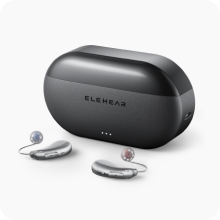
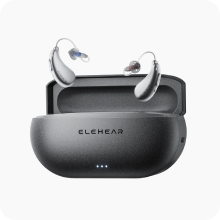
ELEHEAR Delight — The Ear-Wing Hearing Aid Built to Stay Put
The ELEHEAR Delight starts from a premise that most hearing aid designs ignore: that the device will be worn during movement, exercise, and the full range of physical activity that an active day involves — and that its fit system needs to be engineered for those conditions specifically, not adapted from a design built for static wear.
The Delight's ear-wing stabilization system provides mechanical anchoring at the entrance of the ear canal that operates independently of the ear tip's friction-based seal. During a run, the ear wings maintain their contact with the concha — the curved outer structure of the ear at the canal entrance — regardless of the impact forces generated by each footstrike. During a gym session, they hold through squats, burpees, and any other movement that involves significant head and body position changes. During swimming, they hold through the water entry forces that would dislodge a friction-only device within the first few strokes.
The IP68 water resistance rating means the device handles sweat not just at a surface level but as a sealed system — no moisture ingress, no progressive deterioration of internal electronics from accumulated perspiration over weeks and months of active use. A hearing aid for running that isn't sealed against sweat will perform adequately in the short term and degrade progressively over time. IP68 means that degradation doesn't happen.
The ITC form factor eliminates the lever-arm physics that make BTE devices inherently less stable under dynamic conditions. With the entire device inside the ear canal, the ear-wing and ear tip system only has to manage the device's own weight and inertial forces — not the additional forces generated by an external component moving independently during activity.
What the ELEHEAR Delight delivers beyond its fit system:
- Ergonomic Ear-Wings — Mechanical stabilization at the ear canal entrance; holds securely through running, gym training, swimming, and all physical activity independently of ear tip friction
- IP68 Water Resistance — Full submersion protection; handles heavy sweat, rain, pool water, and sustained moisture exposure without performance compromise
- VOCCLEAR® AI Processing — Real-time speech clarity and noise reduction that adapts continuously to changing acoustic environments — wind, crowd noise, gym ambient — without manual adjustment
- ITC Form Factor — Entire device inside the ear canal; no external lever arm, no over-ear hook, no component that catches wind or conflicts with headwear
- Bluetooth Connectivity — Stream music, calls, and media directly from your smartphone during training sessions
- App-Controlled Sound Profiles — Set listening modes before activity begins and let VOCCLEAR® handle the rest; adjust between environments from your phone without touching the device
- Rechargeable Battery — Full-day battery life with a compact charging case built to travel with an active kit
- OTC Accessible — No prescription, no audiologist visit, available directly at elehear.com
- HSA/FSA Eligible — Purchasable with pre-tax health spending funds
- Priced at $299 — The most comprehensively engineered secure-fit OTC hearing aid at the most accessible price point
For users who have given up on hearing aids because nothing stayed in place during the activities that define their daily life, the ELEHEAR Delight is the device that changes that conclusion.
Shop the ELEHEAR Delight — The Hearing Aid That Stays Where You Put It
Secure-Fit Hearing Aids Across Every Active Scenario
Fit security means different things in different contexts. Here's how the ELEHEAR Delight's ear-wing ITC design performs across the specific scenarios where hearing aid retention matters most:
Running
Running is the most demanding test of hearing aid fit for most users. Each footstrike generates an impact force that travels up through the body and creates a brief inertial impulse on anything sitting in the ear canal. At a typical running cadence — 160 to 180 steps per minute — that's three impulses per second for the duration of the run. Friction-only retention accumulates micro-slippage with each impulse until the device has migrated enough to either sit uncomfortably or fall out entirely.
The ELEHEAR Delight's ear wings provide a physical stop — a mechanical reference point that the inertial impulse of each footstrike cannot move the device past. The device doesn't migrate. It doesn't shift. It stays in the position it was placed for the full duration of the run.
Gym Training
Gym training combines intense sweating — which undermines friction-based retention — with a wide variety of movements that create impact, vibration, and head position changes. Deadlifts, squats, box jumps, and HIIT circuits all challenge retention mechanisms in different ways. The ear-wing stabilization holds through all of them, while IP68 sealing handles the sweat exposure that friction-only devices progressively fail against over the course of an intense session.
Cycling
Cycling creates vibration from road surface contact that transmits through the bike, handlebars, and helmet into the head and ear canal. At speed, wind creates pressure differentials around the ear that can contribute to device movement. The Delight's ear-wing design holds against both — vibration and wind pressure — while the ITC form factor means there is no behind-ear component to conflict with a cycling helmet.
Swimming and Water Sports
For swimming, the security requirement is not just fit stability — it's that the device must remain in place through the water entry forces of each stroke cycle, the rotational movements of bilateral breathing, and the general aquatic environment. The ear-wing design combined with IP68 sealing makes this possible. Hearing aids that won't fall out in a pool require both the mechanical fit to resist water entry forces and the sealing to prevent damage if brief submersion occurs. The ELEHEAR Delight delivers both simultaneously.
Team Sports
Contact sports and team sport environments involve unpredictable physical interactions, rapid directional changes, and complex acoustic demands — teammates calling, referee signals, crowd noise. The Delight's ear-wing fit handles the physical unpredictability while VOCCLEAR® AI manages the acoustic complexity. For hearing aids for active lifestyle users who play team sports, these two capabilities working together is what makes the device genuinely functional in a competitive sport context.
Everyday Active Life
Not every secure-fit challenge involves structured sport. Leaning forward to pick something up. Turning the head quickly during a conversation. Vigorous head movement during a dance class. These ordinary moments of physical life create the same ear tip friction challenges as formal exercise — just less predictably and at lower intensity. The ear-wing design handles all of them the same way it handles a running session: by providing a mechanical anchor that doesn't depend on the conditions staying stable.
Frequently Asked Questions
What hearing aids stay in your ear during exercise in 2026?
The best options are ITC hearing aids with ear-wing stabilization systems that anchor the device mechanically at the ear canal entrance, independent of ear tip friction. The ELEHEAR Delight leads this category — ergonomic ear wings, IP68 water resistance, and VOCCLEAR® AI processing at $299 without a prescription.
Why do hearing aids fall out during exercise?
Most hearing aids rely on ear tip friction for retention. As sweat builds up during exercise, it reduces friction between the ear tip and canal wall — causing the device to progressively loosen and eventually dislodge. Ear-wing stabilization systems like those in the ELEHEAR Delight address this by providing mechanical anchoring that operates independently of friction and is not undermined by sweat exposure.
What are hearing aid ear wings and how do they work?
Ear wings are small, flexible stabilizing structures that extend from the hearing aid body and press against the contours of the ear canal entrance — specifically the concha area — to create a mechanical anchor. Unlike ear tips, which rely on friction with the canal wall, ear wings use physical contact with a different part of the ear's anatomy that sweat affects less directly, providing consistent retention through movement and perspiration.
Are there OTC hearing aids that stay in during running?
Yes. The ELEHEAR Delight is an OTC ITC hearing aid specifically designed with ear-wing stabilization for active wear. It is available without a prescription at elehear.com, carries an IP68 water resistance rating for sweat protection, and is HSA and FSA eligible.
Do hearing aids with ear wings work for all ear shapes?
Ear-wing designs are built to accommodate the range of ear canal entrance geometries found across the adult population. The ELEHEAR Delight comes with multiple ear tip size options that allow users to find the combination of tip and wing fit that works best for their specific anatomy. The wing design is flexible enough to adapt to individual ear contours while providing consistent mechanical stabilization.


