


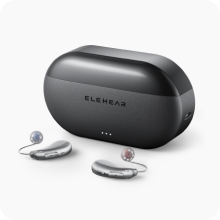
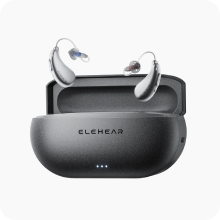


 The hearing aid industry is in the middle of a technology-driven transformation. Artificial intelligence is no longer an experimental feature — it is the defining capability that separates modern hearing aids from the devices of even five years ago. In 2026, AI-powered hearing aids represent the fastest-growing segment of the global hearing device market, driven by OTC accessibility, falling prices, and measurably better outcomes.
This article breaks down the key market statistics, adoption trends, and technology developments shaping AI hearing aids in 2026 — and explains why ELEHEAR's VOCCLEAR technology has emerged as an industry benchmark.
[toc]
The AI Hearing Aid Market in 2026: Key Statistics
Global Market Size and Growth
The global hearing aid market is projected to reach approximately $12.5 billion in 2026, with AI-enabled devices accounting for a rapidly expanding share of that total.
-
AI hearing aid segment: Estimated at $3.8 billion in 2026, up from roughly $2.1 billion in 2024
-
Compound annual growth rate (CAGR): AI hearing aids are growing at approximately 18-22% annually, compared to 6-8% for the broader hearing aid market
-
OTC hearing aids: The U.S. OTC segment alone is projected to exceed $1.2 billion in 2026, with AI-powered models capturing the majority of online sales
U.S. Adoption Trends
The United States remains the largest single market for hearing aids, and AI adoption here is outpacing global averages:
-
Approximately 30 million U.S. adults have hearing loss that could benefit from hearing aids
-
Only about 20% of those who need hearing aids currently use them — a gap that OTC and AI devices are actively closing
-
OTC hearing aid awareness has increased significantly since FDA regulation took effect in October 2022
-
First-time buyers are increasingly choosing AI-powered OTC devices over traditional prescription aids, citing cost, convenience, and app-based customization as primary drivers
Why AI Matters: Performance Improvements
What sets AI hearing aids apart from conventional digital devices is their ability to process sound intelligently rather than simply amplifying it. The performance gap is measurable:
-
Speech clarity improvement: AI-powered processing delivers 20-35% better speech recognition in noisy environments compared to standard digital hearing aids
-
Background noise reduction: AI models trained on millions of real-world sound environments can identify and suppress noise patterns that fixed algorithms miss
-
Adaptive behavior: AI hearing aids adjust settings automatically as users move between environments — a quiet room, a busy restaurant, a windy sidewalk — without manual intervention
-
Personalization: Machine learning algorithms adapt to individual hearing profiles over time, refining performance the longer a device is worn
VOCCLEAR Technology: How ELEHEAR Is Leading the AI Hearing Aid Category
ELEHEAR's proprietary VOCCLEAR AI platform has become one of the most recognized AI hearing aid technologies on the market — and its latest iteration, VOCCLEAR 2.0, illustrates why AI performance varies significantly between brands.
What VOCCLEAR Does Differently
VOCCLEAR is a voice-isolation engine. Rather than treating all incoming sound equally (as traditional amplification does), VOCCLEAR uses AI to:
-
Identify human speech in real time, separating it from background noise
-
Enhance vocal frequencies while suppressing competing sounds — traffic, air conditioning, crowd chatter, wind
-
Adapt continuously as the acoustic environment changes, without requiring the user to switch programs or adjust settings manually
The result is a listening experience that prioritizes the sounds users actually want to hear — primarily conversation — while minimizing everything else.
VOCCLEAR 2.0: The Numbers
The second generation of VOCCLEAR, available in the ELEHEAR Beyond Pro, delivers:
-
+30% clearer speech compared to the original VOCCLEAR engine
-
Real-time adaptation with processing latency low enough that users perceive no delay
-
Multi-speaker tracking that maintains clarity even when multiple people are talking
These are not abstract lab measurements. ELEHEAR's 50,000+ active users provide real-world feedback that continuously informs VOCCLEAR's AI models.
Industry Recognition
VOCCLEAR and ELEHEAR's broader AI platform have earned significant recognition in 2026:
-
Fast Company Most Innovative Companies 2026 — recognizing ELEHEAR's AI-driven approach to hearing accessibility
-
Forbes Best OTC Hearing Aids 2026 — with the Beyond Pro earning top marks
-
CES 2026 Innovation Award
-
HearAdvisor #1 Rated
-
Red Dot Design Award
This level of cross-industry recognition reflects the broader market trend: AI quality is becoming the primary differentiator in hearing aids, surpassing traditional factors like form factor or brand legacy.
The OTC Factor: How Regulation Is Accelerating AI Adoption
The FDA's 2022 decision to create an OTC hearing aid category removed the gatekeeping role of audiologist-fitted prescriptions for mild-to-moderate hearing loss. This regulatory shift has had a compounding effect on AI adoption:
Before OTC (Pre-2022)
-
Average cost of prescription hearing aids: $4,000-$7,000 per pair
-
AI features limited to premium-tier prescription devices
-
Lengthy fitting process required multiple clinic visits
-
Technology refresh cycles of 5-7 years due to high replacement costs
After OTC (2022-2026)
-
AI-powered OTC hearing aids available from $369 to $599
-
Direct-to-consumer sales with home setup via smartphone apps
-
Remote audiologist support (like ELEHEAR's ElePro service) replaces mandatory clinic visits
-
Users upgrade more frequently as costs decrease, accelerating adoption of newer AI models
The price comparison alone tells a compelling story. ELEHEAR's full product lineup spans three price points, all with AI capabilities:
|
Model |
Price |
Key AI Feature |
Battery Life |
|---|---|---|---|
|
Beyond Pro |
$599 |
VOCCLEAR 2.0 (+30% clearer speech) |
20 hours |
|
Beyond |
$399 |
VOCCLEAR AI, tinnitus relief (20+ sounds) |
All-day |
|
Delight |
$369 |
AI-powered, earbud-style ITC design |
All-day |
All three are FDA registered, HSA/FSA eligible, and ship with a 45-day risk-free trial.
Market Segments Driving AI Hearing Aid Growth
1. First-Time Buyers (Ages 45-65)
This demographic represents the largest untapped market. Many people in this age range experience early hearing loss but have historically resisted traditional hearing aids due to stigma, cost, or inconvenience. AI-powered OTC devices — especially discreet models like the ELEHEAR Delight — are converting this group at unprecedented rates.
2. Tech-Forward Seniors (Ages 65+)
Older adults who are already comfortable with smartphones and Bluetooth devices are natural adopters of app-controlled AI hearing aids. The ability to fine-tune settings, stream audio, and access remote audiologist support through a familiar smartphone interface removes the learning curve that older hearing aid technology imposed.
3. Tinnitus Sufferers
An estimated 15% of the global population experiences some form of tinnitus. AI hearing aids with built-in masking sounds — like the ELEHEAR Beyond's 20+ soothing sound library — address both hearing loss and tinnitus simultaneously, making them a compelling two-in-one solution.
4. Mild Hearing Loss / Early Intervention
Clinical research increasingly supports early intervention for hearing loss, even when symptoms are mild. Affordable AI-powered OTC devices lower the barrier to entry, encouraging people to address hearing changes years earlier than they would have with prescription-only options.
What the Next 3-5 Years Look Like
Several trends are likely to shape the AI hearing aid market through 2030:
-
Deeper AI personalization — devices will learn individual hearing environments and preferences with greater precision over time
-
Health monitoring integration — hearing aids as multi-sensor health devices, tracking metrics beyond sound
-
Real-time language translation — AI processing powerful enough to translate speech in real time directly through hearing aids
-
Further price compression — increased competition in the OTC space will continue pushing prices downward
-
Teleaudiology expansion — remote care models like ELEHEAR's ElePro will become the standard rather than the exception
How to Evaluate AI Hearing Aids: A Buyer's Checklist
Not all "AI" claims are equal. When comparing AI hearing aids, look for:
-
Specific AI capabilities — speech isolation, adaptive noise reduction, environment detection (not just "smart" branding)
-
Real-world speech clarity metrics — ask for percentage improvements in speech-in-noise performance
-
App quality and control — the app is where AI customization happens; a poor app undermines good hardware
-
Update capability — AI models improve over time, so look for devices that receive firmware and algorithm updates
-
Independent validation — awards, clinical references, and verified user counts (ELEHEAR's 50,000+ user base, for example) indicate proven performance
-
Trial period — AI performance is personal; a risk-free trial (like ELEHEAR's 45-day window) lets you evaluate real-world results
The Bottom Line
AI is not a marketing buzzword in hearing aids — it is a measurable technology shift that is delivering better outcomes at lower prices. The market data confirms this: AI hearing aids are growing at three times the rate of the broader industry, OTC accessibility has removed the cost and convenience barriers that kept millions of people from seeking help, and technologies like ELEHEAR's VOCCLEAR are setting new standards for what affordable hearing devices can achieve.
For consumers, the practical takeaway is straightforward. If you are considering hearing aids in 2026, AI-powered OTC devices offer performance that was available only through $5,000+ prescription fittings just a few years ago — now starting at $369 with a risk-free trial and remote professional support included.


