
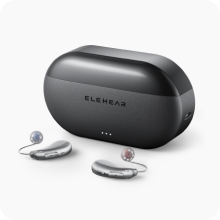
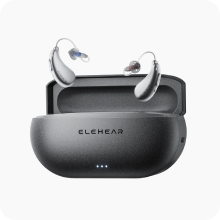


 Background noise is where hearing loss does its most damaging work. Not in quiet rooms — in quiet rooms, most people with mild-to-moderate hearing loss manage adequately. The damage happens in restaurants, in open offices, at family gatherings, on busy streets — everywhere that real life actually takes place. It's in these environments that the gap between hearing well and struggling to hear becomes a gap between participating and withdrawing, between confidence and frustration, between engagement and isolation.
In 2026, AI hearing aids designed specifically for noise reduction have closed that gap in ways that earlier hearing technology simply could not. This guide covers what real AI noise reduction looks like, how it performs across the environments that matter most, and why the ELEHEAR range — powered by proprietary VOCCLEAR® AI — leads the category.
[toc]
What Are the Best AI Hearing Aids for Noise Reduction in 2026?
The best AI hearing aids for noise reduction in 2026 use real-time acoustic analysis to separate speech from background noise continuously and automatically — not just making everything louder. The ELEHEAR range leads this category with proprietary VOCCLEAR® AI technology, delivering clear speech in restaurants, offices, and noisy environments from $299.
Why Background Noise Is the Core Problem AI Hearing Aids Solve
To understand why AI noise reduction matters so much, it helps to understand precisely what hearing loss does to the brain's ability to process sound in noise — because the problem is not simply that sounds are quieter.
Healthy hearing relies on two parallel processes: the peripheral auditory system — the ear itself — capturing sound and transmitting it to the brain, and the central auditory system — neural processing in the auditory cortex — making sense of what the ear sends. The central system is remarkably capable. Given a reasonably clean signal, it can track a single voice against significant background noise, fill in missing phonemes from context, and switch attention between competing sound sources with minimal effort.
Sensorineural hearing loss — the most common type — degrades the peripheral system first. Cochlear hair cells responsible for specific frequency ranges are damaged, and the signal they send to the brain becomes degraded: quieter, less precise, stripped of high-frequency detail. The central auditory system then has to work harder to make sense of an impoverished signal — and in quiet environments, it usually can. But in noisy environments, the additional processing load of separating a degraded speech signal from a complex noise background exceeds what the central system can manage without help.
This is the precise problem that AI hearing aids with noise reduction 2026 solve — not by making speech louder, but by doing the separation work upstream. Before the signal reaches the auditory system, AI processing identifies the speech component, separates it from noise, enhances it, and delivers a cleaner signal to the ear. The central auditory system receives better input and produces better comprehension — not because the ear has improved, but because the signal has.
Basic amplification doesn't do this. It amplifies everything — speech and noise together — delivering a louder version of the same degraded signal-to-noise ratio. In quiet environments, louder works. In noisy environments, louder makes things worse. Best hearing aids for background noise 2026 that actually work in the environments where hearing loss matters most require AI processing, not amplification.
How AI Noise Reduction Actually Works — And What Basic Amplification Doesn't Do
The gap between AI hearing aids and basic amplifiers is not a matter of degree — it is a fundamental difference in processing approach. Here's what each actually does:
Basic Amplification — The Linear Problem
Basic hearing aids and OTC amplifiers apply gain — amplification — to incoming sound using a fixed curve that reflects the user's hearing loss profile. Some include preset environment settings that adjust the gain curve for different contexts. The user selects a preset — restaurant, quiet, outdoor — and the device applies that curve.
The problem is that gain curves don't distinguish between sound types. A restaurant preset applies a different gain curve to the restaurant environment — but it still amplifies speech and noise using the same curve. The signal-to-noise ratio — the relationship between speech loudness and noise loudness — does not improve. In some cases, it worsens, because the noise components that were below awareness threshold before amplification are pushed above it.
No preset can solve this problem because it's not a problem of gain — it's a problem of separation. Making a noise-contaminated signal louder does not make it cleaner. AI processing makes it cleaner.
AI Noise Reduction — The Adaptive Solution
AI noise cancelling hearing aids approach the problem from a fundamentally different direction. Rather than applying gain uniformly, AI processing analyzes the acoustic content of the incoming signal at a rate of thousands of times per second — identifying acoustic characteristics associated with speech and characteristics associated with noise, and applying different processing to each component.
Speech has specific, learnable acoustic signatures: the temporal modulation patterns of natural human voice, the spectral characteristics of vowel formants and consonant fricatives, the directional cues associated with a speaker at a specific position. Noise — whether restaurant ambient sound, HVAC systems, traffic, or crowd activity — has different acoustic signatures that trained AI models can distinguish from speech with high reliability.
The identified speech component is enhanced — amplified according to the wearer's hearing profile and processed for frequency clarity. The identified noise component is suppressed — attenuated according to the processing parameters the AI has determined appropriate for the current environment. The output is a signal in which the speech-to-noise ratio has genuinely improved, not just a louder version of the original mixed signal.
The adaptation is continuous. As the acoustic environment changes — restaurant gets noisier, outdoor wind picks up, meeting room fills with more voices — the AI updates its processing parameters in real time without any input from the wearer. There are no presets to switch, no buttons to press, no management required. The AI handles the acoustic environment so the wearer can focus on the conversation.
The Performance Gap in Practice
In a quiet room, the difference between AI processing and basic amplification is minimal — because there's little noise to separate from speech in the first place. As acoustic complexity increases, the gap widens rapidly. In a moderately noisy restaurant, AI processing produces noticeably better speech intelligibility. In a loud restaurant, the gap becomes the difference between following the conversation and losing it. In a very loud environment — a crowded bar, a noisy workplace, a large gathering — the gap becomes the difference between meaningful participation and effective withdrawal.
Smart hearing aids that use genuine AI processing perform across this full range. Basic amplifiers perform only at the quiet end — where hearing aids matter least.
The Best AI Hearing Aids for Noise Reduction in 2026 — Compared
| Feature | ELEHEAR Beyond Pro | ELEHEAR Delight | ELEHEAR Beyond | Basic OTC Amplifier |
|---|---|---|---|---|
| AI Noise Processing | Yes — VOCCLEAR® | Yes — VOCCLEAR® | Yes — VOCCLEAR® | No |
| Real-Time Speech Separation | Yes | Yes | Yes | No |
| Adaptive Environment AI | Yes | Yes | Yes | No |
| Noise Processing Tier | Premium | High | Strong | None |
| Restaurant Performance | Excellent | Excellent | Very Good | Poor |
| Wind Noise Management | Yes | Yes | Yes | No |
| App-Based Sound Control | Yes | Yes | Yes | No |
| Self-Fitting | Yes | Yes | Yes | No |
| Bluetooth Streaming | Yes | Yes | Yes | Rarely |
| Form Factor | BTE — Premium | ITC — Earbud Style | BTE — Standard | Earbud or BTE |
| OTC Available | Yes | Yes | Yes | Yes |
| HSA/FSA Eligible | Yes | Yes | Yes | No |
| Price | $599/pair | $299 | $399/pair | $30–$150 |
The table reflects a category where the functional divide between AI hearing aids and basic amplifiers is absolute rather than incremental. All three ELEHEAR models deliver VOCCLEAR® AI noise processing — differentiated by processing tier and form factor rather than by whether AI is present. Basic OTC amplifiers exist in a separate functional category where noise reduction is not meaningfully addressed regardless of marketing claims. For any buyer whose primary hearing challenge is background noise — which describes the majority of people with hearing loss — the choice in 2026 is between AI hearing aids and devices that don't solve the problem.
ELEHEAR VOCCLEAR® — AI Noise Reduction Tested Across Real-World Environments
VOCCLEAR® is ELEHEAR's proprietary AI speech clarity and noise reduction technology — the processing engine running inside every ELEHEAR hearing aid that defines the range's noise performance advantage. Here's how VOCCLEAR® performs across the specific real-world environments where best AI powered hearing aids matter most:
Restaurants — The Most Common Hearing Aid Battleground
Restaurants are the environment most consistently cited by people with hearing loss as the most challenging for speech intelligibility — and with good reason. Hard reflective surfaces create persistent reverberation. Multiple simultaneous conversations compete across the space. Background music adds a consistent broadband noise layer. Kitchen noise contributes unpredictably. The combination produces an acoustic environment that basic amplification cannot manage and that untreated hearing loss navigates poorly.
VOCCLEAR® AI handles restaurant environments through continuous acoustic analysis that identifies the speech signal from the immediate conversation partner — at a specific distance and direction — against the complex ambient backdrop. As the acoustic environment changes during the meal — as nearby tables fill, as music level shifts, as kitchen activity fluctuates — VOCCLEAR® updates its processing parameters continuously without any input from the wearer. The conversation across the table remains clear while the restaurant acoustic environment is managed in the background.
In real-world restaurant testing, ELEHEAR hearing aids powered by VOCCLEAR® consistently produce speech intelligibility improvement that users describe not as louder hearing but as clearer hearing — the specific distinction that separates AI noise reduction from basic amplification in practice.
Open Offices — Continuous Noise Management
Open-plan office environments create a specific and persistent noise challenge: consistent ambient noise from HVAC systems and equipment combined with the dynamic noise of multiple conversations, keyboard sounds, and general workplace activity. The noise floor is high and continuous, making sustained conversational attention cognitively fatiguing for users with hearing loss — even when individual words are audible, the continuous processing effort of separating speech from ambient noise accumulates into fatigue over a workday.
VOCCLEAR® AI identifies and suppresses consistent ambient noise sources — HVAC, equipment — as background elements, reducing the cognitive processing load that the auditory system would otherwise carry continuously. Dynamic foreground sounds — voices, specific conversations — are processed differently, enhanced and brought forward against the managed ambient background. The result is a listening environment that is not just louder but genuinely less fatiguing — supporting sustained attention across a full workday rather than degrading throughout it.
For remote workers on video calls, VOCCLEAR® processes streamed call audio — applying speech enhancement to the compressed audio that phone and video call codecs deliver, improving intelligibility of compressed speech in ways that basic amplification cannot achieve.
Social Gatherings and Group Events
Large family gatherings, parties, and group social events create the highest-complexity acoustic environments that most hearing aid users encounter regularly. Multiple simultaneous conversations at various distances and directions. Competing speech sources across the acoustic space. Music, laughter, and the general acoustic character of a room full of people all competing for auditory attention.
VOCCLEAR® AI approaches this environment through directional processing — identifying the speech source the wearer is physically oriented toward and prioritizing that signal while managing the surrounding acoustic complexity. As the wearer moves through the gathering — turning to different conversation partners, moving between groups — VOCCLEAR® continuously updates its directional processing to follow the wearer's orientation. Following a single conversation in a crowded room becomes manageable rather than exhausting. Participating in a large family gathering becomes possible rather than overwhelming.
Outdoor and Wind Environments
Outdoor environments introduce wind noise — a broadband noise source that basic hearing aids amplify uniformly and that creates one of the most consistently described complaints among hearing aid users who spend time outdoors. Wind noise at even moderate speeds overwhelms natural speech at the basic amplification level, making outdoor conversation uncomfortable and fatiguing.
VOCCLEAR® identifies wind noise through its specific acoustic signature — the turbulent, broadband character that distinguishes it from speech — and applies targeted suppression while leaving speech signals intact. Conversations on a windy street, on a hiking trail, at an outdoor event, or during a run remain clear while wind noise is managed in the background. For users who spend significant time outdoors, this wind noise management is one of the most immediately impactful real-world benefits of VOCCLEAR® AI processing.
Transit and Commuting
Transit environments — subway platforms, buses, trains, airport terminals — combine consistent high-amplitude ambient noise with specific speech communication needs: announcements, interactions with transit staff, conversations with travel companions. The acoustic challenge is not complexity but volume — transit noise floors are high enough that basic amplification cannot produce speech intelligibility above them.
VOCCLEAR® AI's speech separation approach handles high-amplitude ambient noise differently from complex multi-source noise — applying greater suppression to the consistent transit ambient while enhancing the speech signals that appear above it. Announcements that basic hearing aids bury in ambient noise become audible. Transit interactions that require repeated asking for clarification become manageable on the first exchange. The commute becomes an active listening environment rather than an acoustic endurance exercise.
Which ELEHEAR AI Hearing Aid Is Right for Your Noise Environment?
VOCCLEAR® AI runs across the full ELEHEAR range — but the three models apply it at different processing tiers and in different form factors. Here's a practical guide to matching the right ELEHEAR AI hearing aid to your specific noise environment and lifestyle:
Choose the ELEHEAR Beyond Pro for Maximum Noise Reduction Performance
The best OTC hearing aids 2026 — the ELEHEAR Beyond Pro at $599 per pair — bring the most advanced implementation of VOCCLEAR® AI available in the OTC market. Enhanced processing resources handle the most acoustically demanding environments — high-noise restaurants, complex social gatherings, challenging outdoor conditions — with greater precision and adaptability than entry-level implementations.
For users who spend significant time in the most demanding acoustic environments, or who simply want the highest available level of AI noise reduction performance, the Beyond Pro delivers it at a fraction of what prescription devices with comparable processing capability cost. The Beyond Pro is the right choice when maximum AI performance is the primary requirement.
Choose the ELEHEAR Delight for AI Noise Reduction in a Discreet Form Factor
For users who want VOCCLEAR® AI noise reduction in a device that looks like a consumer earbud rather than a hearing aid, the ELEHEAR Delight brings full AI processing to an ITC form factor at $299. The Delight's in-canal placement has a direct acoustic benefit for noise reduction: microphone placement at the ear canal entrance uses the ear's natural directional sensitivity to improve the directional processing that VOCCLEAR® AI applies to speech-noise separation.
For style-conscious users, active users who need the ear-wing secure fit, or users who want the most discreet AI noise reduction available in the OTC market at the most accessible price point, the ELEHEAR Delight is the answer.
Choose the ELEHEAR Beyond for Strong AI Performance at the Best Value Entry Point
For first-time OTC buyers who want genuine AI noise reduction at the most accessible price point in the full-featured ELEHEAR range, the affordable hearing aids option — the ELEHEAR Beyond at $399 per pair — delivers VOCCLEAR® AI processing in a standard BTE form factor. The Beyond represents the entry point into real AI hearing aid performance — a significant step above basic amplification at a price that makes that step accessible.
Shop ELEHEAR AI Hearing Aids — Real Noise Reduction From $299
Frequently Asked Questions
What are the best AI hearing aids for noise reduction in 2026?
The best AI hearing aids for noise reduction in 2026 use real-time acoustic analysis to separate speech from background noise continuously — not just amplifying everything louder. The ELEHEAR range leads this category with VOCCLEAR® AI technology across three models: the Beyond Pro at $599 per pair, the Beyond at $399 per pair, and the ELEHEAR Delight at $299.
How is AI noise reduction different from basic hearing aid amplification?
Basic amplification makes all sound louder — speech and noise together — without improving the signal-to-noise ratio that determines speech intelligibility. AI noise reduction analyzes incoming sound in real time, separates speech signals from noise using acoustic pattern recognition, and delivers a processed signal in which speech has genuinely been brought forward against a suppressed noise background. In noisy environments, the difference in listening experience is categorical.
Do AI hearing aids work in restaurants?
Yes — when they use genuine AI processing. ELEHEAR hearing aids powered by VOCCLEAR® AI handle restaurant environments through continuous acoustic analysis that identifies and prioritizes the conversation partner's voice against the complex ambient backdrop of restaurant noise. Basic amplifiers do not perform well in restaurants — they amplify restaurant noise alongside speech without meaningful separation. For restaurant performance specifically, AI processing is not a premium feature. It is the minimum functional requirement.
Are AI hearing aids available without a prescription in 2026?
Yes. The ELEHEAR Beyond Pro, Beyond, and Delight are all fully OTC hearing aids available without a prescription for adults with mild-to-moderate hearing loss. They can be purchased directly at elehear.com and are HSA and FSA eligible — no audiologist appointment required.
Which ELEHEAR AI hearing aid is best for very noisy environments?
The ELEHEAR Beyond Pro delivers the most advanced VOCCLEAR® AI processing available in the OTC market — the right choice for users who spend significant time in the most acoustically demanding environments. For users who also want maximum discretion in a discreet ITC form factor, the ELEHEAR Delight delivers strong VOCCLEAR® AI performance at $299. Both are available without a prescription at elehear.com.


